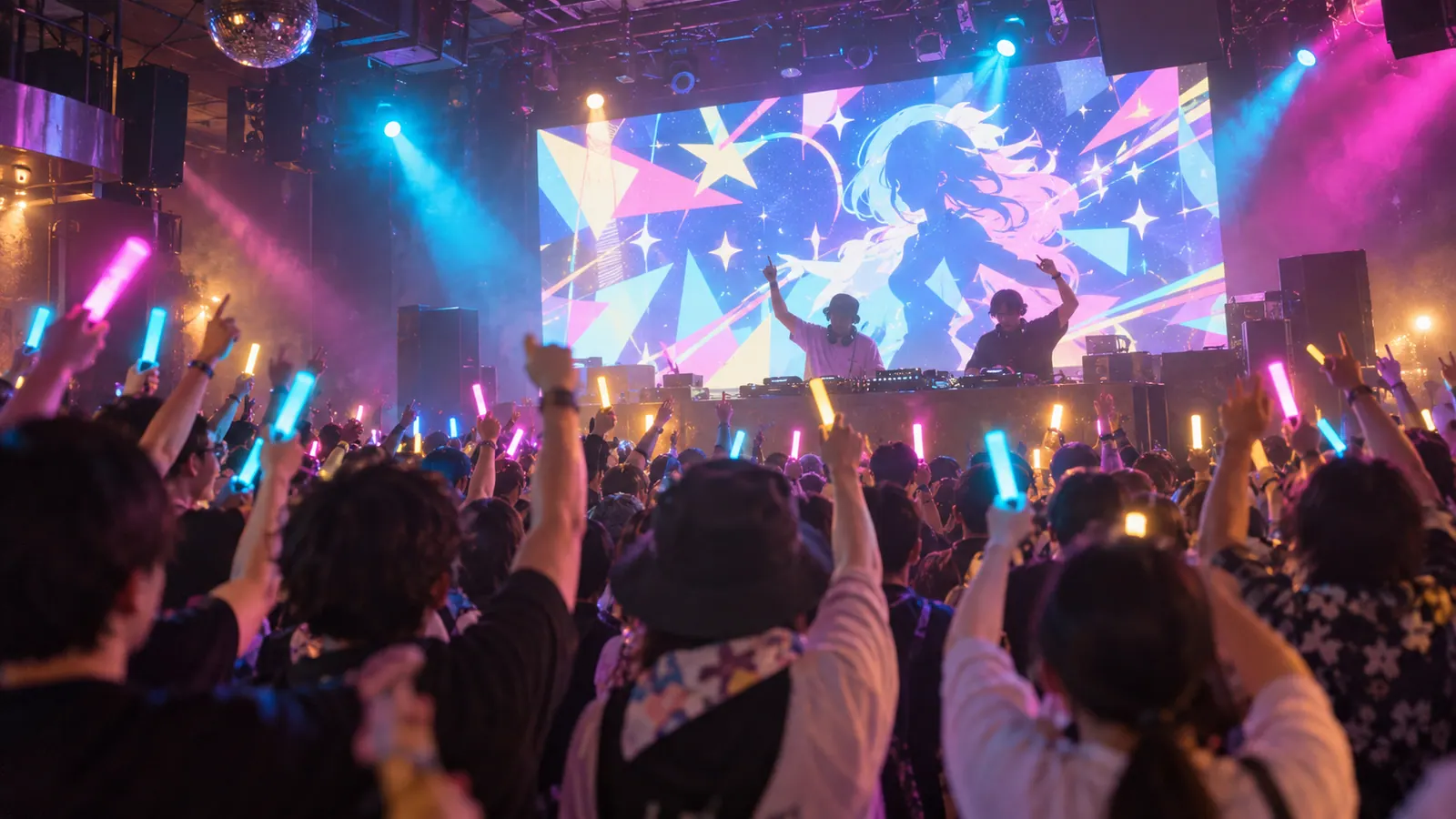
You’ve seen the flyers: pastel character art, a lineup of DJ names you don’t recognize, and somewhere in the corner the word アニクラ. Maybe a friend has dragged you to one, or you’ve watched a clip of a floor screaming the chorus of an anime opening and wondered what on earth was going on. This is the explainer I’d give you over a drink, from someone who DJs in Tokyo and spends a lot of nights at these parties.
What anikura actually is
Anikura (アニクラ) is short for “anison club” — a club night where the DJs play anime songs. You’ll also see it written あにくら, or on flyers as アニソンDJイベント (“anisong DJ event”) and アニソンクラブイベント. Same thing.
Mechanically it’s a normal club night: DJs rotate every 30 to 60 minutes, there’s a bar, there’s a floor. The only difference is the source material. And that one difference changes the room completely.
“Anisong” here is a loose umbrella. Anime openings and endings are the core, but game soundtracks, tokusatsu themes, idol-anime franchises, VTuber songs and Vocaloid all wander in. When a night goes Vocaloid wall-to-wall, the scene calls it a bokakura — I wrote a whole piece on those if that’s more your lane.
What plays
Expect the decades to bounce around all night. A 90s classic like “A Cruel Angel’s Thesis” drops and the entire room — twenty-year-olds included — reacts inside one second. Then it’s a 2010s staple like “only my railgun”, then something recent and enormous like “Gurenge” or YOASOBI’s “Idol”.
DJs have strong personalities, too. Some play the original tracks straight and lean on the sing-along. Some reach for remixes and club edits that hit harder on a big system. Others lock their set to one franchise, or to a theme like “only 2000s shows”. Akihabara MOGRA’s long-running party Anison Index is built around playing the original versions — its 17th-anniversary night in October 2026 is edition number 195. A party that’s been packing a floor with unedited anime songs for that long tells you something about how deep this scene goes.
You don’t need to cram. Knowing the openings of a few shows you’ve actually watched is enough, and the songs you don’t know become your watch list. Here’s how I think about pre-club listening in general.
The floor: a club where you’re allowed to be loud
The first thing that surprises people isn’t the volume of the speakers. It’s the volume of the crowd.
Choruses get sung by the whole room. Some songs come with set calls — shouted responses on the beat, a cheer that goes up the second an intro is recognized. At a techno night everyone sways in silence; at anikura, using your voice is the point. That said, plenty of people hang at the back and just nod along, and nobody notices or cares.
Then there are penlights. Some floors light up and wave like an idol concert, especially on nights heavy with idol-anime franchises. Other nights you won’t see a single one. Bringing one is entirely optional.
The crowd skews twenties, but people who grew up on 2000s anime are still very much out there, so thirties and forties are normal. Gender balance swings by event — nights built around shows with a big female fanbase can be majority women. If age is on your mind, the clubbing-in-your-30s-and-40s piece applies here more than almost anywhere.
”Isn’t it a bit… much?”
Japanese search suggestions for アニクラ include words that translate roughly to “intense” and “cringe”. So let’s just talk about it.
A lot of the “intense” searches are, I suspect, compliments. When a beloved track lands, the energy in the room is something you rarely get in other genres.
The “cringe” reaction is mostly about distance. Full-throated sing-alongs, shouted calls, big choreographed arm movements that come from idol-fan culture — take a fifteen-second clip of that with no context and of course some people recoil. Honestly, the first time I went I laughed a bit too: “they really go all in, huh.”
From the inside, though, it’s just people loving a song with their whole body. Someone with their eyes closed at a minimal techno night and someone screaming a chorus at MOGRA are doing the same thing at the root. Different dialects, same language.
It’s not all perfect. Occasionally someone gets carried away and bumps into people, or stands closer than you’d like. That happens at every kind of club, and some anikura spell out house rules right on the flyer. If something’s off, tell the staff — you don’t have to just put up with it. For club anxieties in general, see Tokyo club fears, taken apart.
Before your first one
Timing. This is the good news: anikura skews heavily toward daytime. Of the anisong events we listed between May and September 2026 with a known start time, more than eight in ten started between noon and 7:59pm. Across all Tokyo DJ events, that figure is somewhere between half and six in ten (full timing research here). You can do your first one in the afternoon and be home on a normal train.
Money. On the anisong events in our index that listed a price, the most common range was ¥2,000–2,500 with a drink included. Anisong DJ bars sometimes run nights as cheap as ¥500 plus a drink; stacked guest lineups can go past ¥3,000. One trick worth knowing: 表明 (hyōmei), literally “declaring”. Some events knock around ¥500 off the door if you declare you’re coming in advance — replying to the organizer’s post, or signing up on TwiPla, a Japanese event-RSVP site. The method varies by event, so read the flyer text. Notation like 1D and W is decoded in how to read Tokyo door pricing, and the bigger picture is in what Tokyo clubs cost.
Going solo. Anikura is one of the easiest scenes in Tokyo to do alone. People come for specific songs and specific DJs, sing, and leave happy. The regulars who look like a tight friend group got that way by showing up a lot — that’s the whole barrier. More in the solo clubbing piece.
Clothes. Whatever you’d normally wear, plus shoes you can jump in. You’ll see character shirts, merch, and some cosplay — MOGRA’s Anison Index even lists a women’s changing room on its official event page. All optional. There’s no “anikura outfit” you need to buy. Dress codes in general are looser in Tokyo than people fear.
ID. This is the one that actually matters. All-night events are commonly 20+ with a photo ID check at the door (Anison Index is). Bring your residence card or passport. Daytime events can be more open — MOGRA’s VOCALOID-ManiaX day event, for example, lists a separate price for 19 and under. Rules differ per event, so check the flyer and carry ID regardless.
Do you need Japanese?
Less than you’d think. The shared language of the floor is the songs, and if you’ve been watching anime for years you already know more of the lyrics than you realize — plenty of international fans learned these songs phonetically long before moving here. Calls you’ll pick up by the second chorus; just copy the people around you. And nobody holds long conversations on the floor anyway, it’s too loud for that everywhere.
Where Japanese helps is the admin: reading flyers, the 表明 discount, and the occasional rule posted only in Japanese. A translation app on the flyer image covers most of it.
A few flyer words worth knowing
- 原曲 (genkyoku) — “original track”. A 原曲 night plays the songs as released, not remixes.
- 縛り (shibari) — “locked to”. 00年代縛り means a 2000s-only set or night; a franchise name plus 縛り means one series only.
- 表明 (hyōmei) — the advance-declaration discount above.
- 1D込 / 2D込 — one or two drink tickets included in the door price.
- 19歳以下 / U-20 — youth pricing, which also tells you the event admits under-20s.
Where it happens
Akihabara is the center of gravity. MOGRA opened in 2009, holds up to 150 people, and describes itself as a DJ event space — it’s about as close to an institution as this scene has. The neighborhood is also home to the anisong DJ bar Alchemist (あるけみすと). Browse what’s coming up in Akihabara anisong events.
Around Shinjuku, there’s Vocabuki in Kabukicho (leaning Vocaloid) and Shinjuku azito. In Shibuya, R Lounge in Udagawacho hosts anisong nights such as Shibuya no Anikura. Area lists: Shinjuku and Shibuya.
Some of the most loyal rooms are a little outside the center: Ryogoku Alchemy (あるけみっ!!), Kowloon (九龍) in Yushima, Gluck in Hachioji, Gluck Zwei in Tachikawa, and Tsukiakari Yume Terasu in Kawasaki. These are anisong DJ bars — places that open most nights with a DJ timetable, rather than one-off parties.
That distinction is worth a sentence. A club event is a party an organizer books for one date. A DJ bar is a regular bar where you can drop in for a drink and hear whoever’s on. Pricing can work differently too — some bars run a time-based charge or an all-you-can-drink plan instead of a door fee. If a full event feels like a lot for a first try, a DJ bar on a quiet weeknight is a gentle entry. DJ bar vs club in Tokyo covers the difference in more depth.
Finding tonight’s anikura
Almost every anikura is announced on X, so long term you’ll end up following organizers and venues you like. Getting started is the hard part, since you don’t know who to follow yet.
That’s what our anison events index is for — Tokyo anisong events in date order, updated daily. Between May and mid-October 2026 we listed around 280 of them, which works out to more than ten a week. If you want to lean Vocaloid, there’s the Vocaloid events index too. Our listings are compiled from announcements, so check the organizer’s latest post before you head out.
Common misconceptions
“You have to be an otaku to get in.” You don’t. Nobody’s quizzing you at the door, and the floor runs on a few songs everyone knows. Hear something you love and don’t know? Ask the DJ after their set, or use one of these tricks.
“It’s a closed in-group.” There are regulars, as with any scene. But it’s less a clique than the same people loving the same songs often enough to know each other. Sing one chorus with them and you’re halfway in.
“It’s a kids’ thing.” The age range is wider than almost anywhere else in Tokyo nightlife. If anything, the older the song, the louder the older half of the room gets.
The short version
- Anikura = anime-song DJ nights; あにくら and アニソンDJイベント mean the same thing
- A club where you’re allowed to be loud: sing-alongs, calls, penlights — all optional
- Mostly daytime and early evening; typically ¥2,000–2,500 with a drink
- Akihabara is the hub, with Shinjuku and Shibuya events and anisong DJ bars in Ryogoku, Hachioji, Tachikawa and Kawasaki
- Bring photo ID, and check the anison events index for dates
If Tokyo clubs in general are still new to you, start with the first-timer guide. And if a few nights in you find yourself wanting to be the one behind the decks, I wrote up how to start as an anisong DJ. See you on the floor.