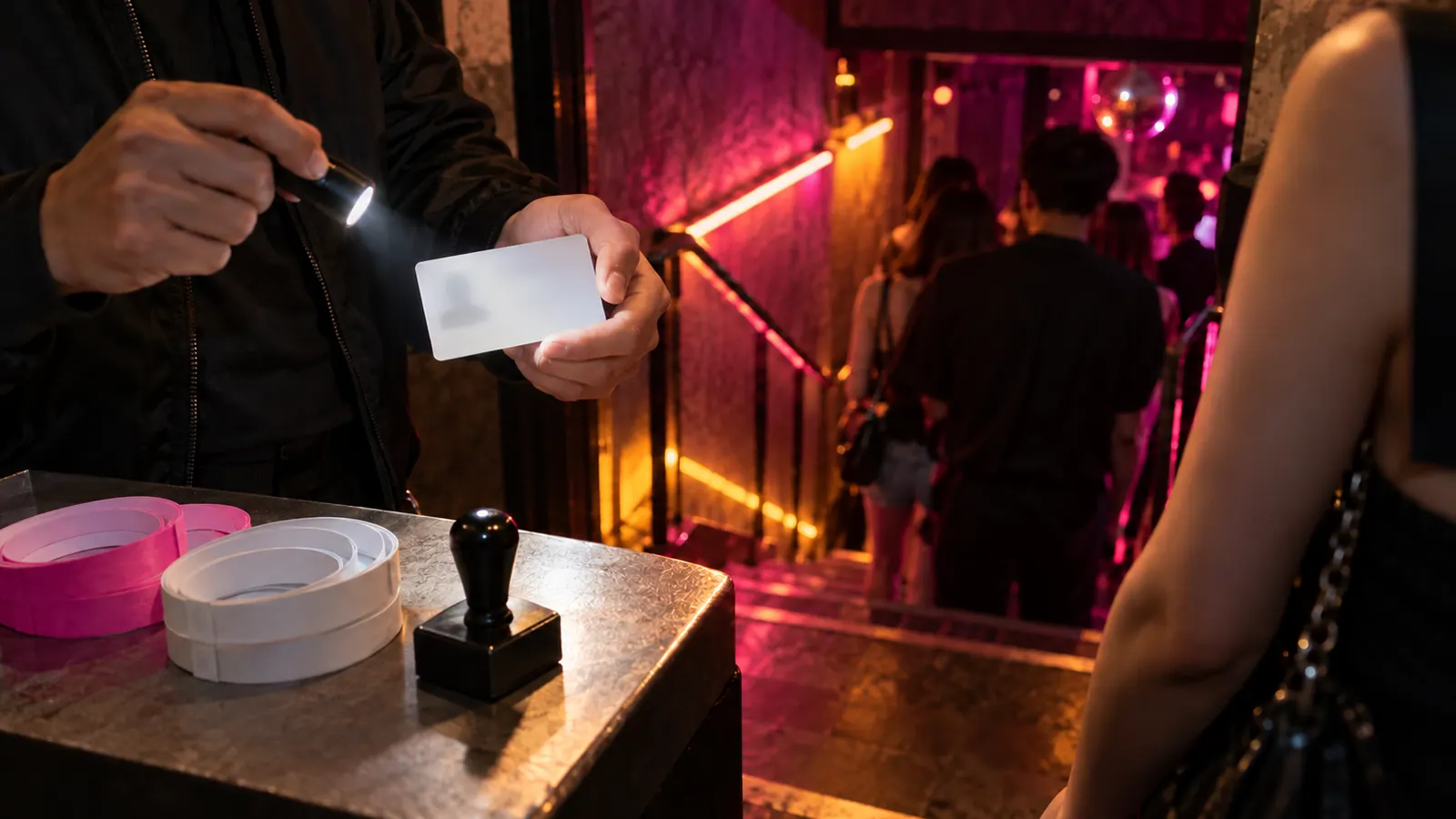
Someone’s little brother is in town for the week. Or you’re 19, just landed on a student visa, and your new classmates are talking about a party in Shibuya. Either way the same question comes up: can I actually get in?
Short version: most Tokyo night events are 20+, and you’ll be asked for photo ID at the door. But that’s mostly the venues’ call, not a number the law spells out. Here’s how the pieces fit together.
The law draws two lines: 18 and 20
18. A venue that serves alcohol and keeps people dancing past midnight needs what the Entertainment Business Act (風営法) calls a “specified entertainment and dining business” licence (特定遊興飲食店営業, Article 2(11)). That category came in with an amendment that took effect in 2016, and it’s where late-night clubs basically sit now. A venue on that licence can’t admit anyone under 18 as a customer between 22:00 and 06:00. The only exception is 22:00 to midnight with a parent or guardian (Article 22(1)(v) as applied by Article 31-23).
Bars serving alcohol have the same 22:00 line for under-18s, again with a guardian exception (Article 32(3)). So whether you’re at a club or a DJ bar, 22:00 is usually where it kicks in.
Tokyo’s youth ordinance adds its own layer. It treats 23:00 to 04:00 as “late night,” and nobody is allowed to take out, accompany or keep someone under 18 out during those hours without a guardian’s consent or a legitimate reason (Article 15-4). That’s worth knowing if you’re the older friend thinking of bringing a high schooler along.
20. Drinking and smoking are 20+ (Article 1 of the two Acts covering drinking and smoking by people under 20). Japan lowered the age of adulthood to 18 in April 2022 (Civil Code Article 4), but alcohol and tobacco stayed at 20.
| Age | What the law says (Tokyo) | Typical night-event house rule |
|---|---|---|
| Under 18 | No entry to late-night clubs or alcohol-serving bars from 22:00, apart from limited guardian exceptions. Tokyo’s 23:00–04:00 rule for minors also applies | Not admitted |
| 18–19 | Not covered by the under-18 rules, but no alcohol or tobacco | Often “no under-20s” |
| 20+ | No age barrier | Photo ID usually checked |
Why venues settle on 20
Read only the law and 18- and 19-year-olds look fine for a night out. The reason most venues draw the line at 20 anyway is the bar.
Anyone selling alcohol is required to take steps such as checking age to stop under-20 drinking (Article 1(4) of the drinking Act), and knowingly serving someone under 20 carries a fine of up to ¥500,000 (Article 3). The Entertainment Business Act separately bans licensed clubs and bars from serving alcohol to under-20s (Article 22(1)(vi), as applied), with penalties of up to a year’s imprisonment or a ¥1 million fine (Article 51). On top of that, the Public Safety Commission can revoke a licence or order up to six months’ suspension when a venue breaks the law (Article 31-25). The Tokyo police form for that licence even has a box asking how you’ll keep under-18s out and how you’ll stop serving alcohol to under-20s.
Now picture a dark, packed floor at 2am and a bar trying to tell a 19-year-old from a 21-year-old every single round. Making night events 20+ and checking everyone at the door is the simpler fix, and it explains why so many venues land there. For the venue it’s a licence-level issue, which is why door staff don’t treat it casually.
You can see it in what venues actually post. ENTER in Shibuya says on its site that you must be over 20 with photo ID and that every guest gets an ID check. WOMB’s and ZEROTOKYO’s FAQs say their regular late-night events are 20+ with photo ID. Circus Tokyo splits it by time: events from 22:00 are no under-20s. MOGRA in Akihabara lists its night events as 20+ with official photo ID.
Waiting by the door before a set, you watch staff compare every face to every card, including people who are very obviously over 20. “I look old enough” doesn’t really get you anywhere.
What ID to bring
WOMB’s FAQ lists a driver’s licence, passport or My Number Card. ZEROTOKYO lists a driver’s licence, passport or Basic Resident Registration Card. If your ID has no photo, like a health insurance card, both say you’ll need a second document with your name and photo on it: a student ID, employee ID or photo credit card.
If you live here on a visa, your residence card (在留カード) is the obvious candidate. Mid- to long-term residents are legally required to carry it at all times (Immigration Control Act, Article 23(2)), and it shows your name, date of birth and photo. But neither WOMB’s nor ZEROTOKYO’s FAQ names it, so for a first night at a big club, having your passport in your bag too takes the question off the table.
Foreign driver’s licences are a mixed picture. MOGRA’s page for overseas visitors explicitly mentions a passport or your home country’s driver’s licence. The bigger clubs’ FAQs just say “driver’s licence” without spelling out whether that includes foreign ones, so a passport is the safer bet.
MOGRA’s page is also clear on one more thing: because of past counterfeiting problems, it won’t accept electronic IDs or ID photos on your phone. Bring the physical card. “Photo ID” means an ID with your photo on it, not a photo of your ID. Some event notices also say staff may ask to see ID again inside, so keep it on you after you’re in.
Forgot it, borrowed it, “they didn’t check me last time”
Forgot your ID? Expect to be turned away, especially at venues that say they check every guest. If home is close, going back for it is the realistic answer. Being on the guest list doesn’t change this, because the age check is separate from your entry fee.
Borrowing a friend’s? Just don’t. Staff are literally comparing the photo to your face, and for the venue it’s a licence issue. You won’t get in, and you’ve dragged your friend and the venue into it. The reason some venues ask for a photo document alongside a no-photo ID is exactly to confirm it’s really you.
“They never checked me before.” Regulars sometimes get waved through because staff know their faces. That’s familiarity, not a different rule. Carrying ID every time is the low-effort option.
Under 20? Go in the daytime
If you’re under 20, the realistic route is daytime and early-evening events. WOMB and ZEROTOKYO both note in their FAQs that earlier or daytime events can come with different age rules, and point you to the event page.
One example: MOGRA’s VOCALOID-ManiaX in October 2026 ran 14:00 to 20:00 with a 19-and-under price, while also requiring photo ID at the door and banning drinking and smoking for under-20s. Across the listings on this site, a fair number of afternoon and early-evening events show “U-18,” “U20” or “high-schoolers and under” pricing. Some split it by drinks, with alcohol plans for adults and a soft-drink-only student rate.
Tokyo’s DJ scene isn’t all 2am starts, either. Our event start-time research found that more than half of events start between 12:00 and 19:59, and fewer than 2% start after midnight. The daytime tag is the fastest way to find them.
One trap: “U-23” pricing, which you’ll see at DJ bars and clubs, means a discount for people 23 and under. It doesn’t mean under-20s are welcome. MOGRA’s night events, for instance, list a 20-to-23 discount and still say no under-20s.
Same goes for “I’m 18 and not in high school.” The Entertainment Business Act and the Tokyo ordinance both draw the line by age (under 18), not by school status. At 18 or 19 you’re past the 22:00 and 23:00 rules, but night events are mostly 20+ by house rule, and alcohol is 20+ regardless.
Before you head out
Most event pages have a block of small print near the bottom covering age and ID. Read that bit, since the same venue can run different rules for a day event and a night event. Then put the physical ID in your wallet, and the door becomes a ten-second thing.